

Orifice Flow for Two-Phase Fluids – Part 2
In Orifice Flow for Subcooled Flashing Liquids and Orifice Flow for Two-Phase Fluids – Part 1, we outlined our effort to verify a calculation model for two-phase orifice flow using the data of Richardson, et al.1 Part 1 covered inlet vapor qualities from 0.2 to 1.0 (liquid mass fractions of 0.0 to 0.8 in Richardson’s notation), where the homogeneous equilibrium method (HEM) produces reliable results. This post addresses the remaining range: inlet quality 0.0 to 0.2, where the fluid entering the orifice is predominantly liquid.
Why this range is harder. Richardson et al. observed three things about the transition region (liquid mass fractions above 0.8) that explain why HEM alone is insufficient:
First, the discharge coefficient for HEM flow is not constant across the full quality range. For Part 1 conditions, it varies from approximately 0.90 for pure gas down to about 0.98 at a liquid fraction of 0.8 with no meaningful dependence on pressure, temperature, or composition, only liquid fraction.
Second, for essentially pure liquid entering the orifice, HEM breaks down even when the equilibrium state at the throat would be two-phase. Richardson’s explanation for this is direct: “the slowness of nucleation to form gas bubbles prevents the liquid forming a two-phase mixture until the stream has completely passed through the orifice.” The result is effectively frozen (non-equilibrium) flow through the restriction, which is the same physical basis that justifies using liquid orifice sizing for subcooled flashing liquids, as we discussed in the earlier post.
Third, as the liquid fraction increases above 0.8, the measured discharge coefficient trends toward values above 1.0 in HEM terms, what Richardson describes as the flow “anticipating the transition to incompressible flow.” This transition behavior is what makes the quality range 0.0–0.2 require a bridging approach rather than a simple extension of HEM.
The interpolation approach. We have two well-supported models at the limits of this range:
- At xth = 0 (saturated liquid at the throat): liquid orifice sizing, as described in Orifice Flow for Subcooled Flashing Liquids. This uses the liquid orifice flow equation with the upstream density evaluated at the saturation pressure, the actual back pressure as the downstream pressure, and the liquid discharge coefficient.
- At xth = 0.2 (the lower bound of Part 1): HEM mass flux integration.
We use the quality at the throat (xth, evaluated at the HEM throat pressure) as the independent variable for interpolation. This follows Richardson’s finding that the throat liquid fraction provides the best correlation with measured behavior, which makes physical sense: the throat state is what actually governs the flow, regardless of what happens upstream.
A quadratic blend between the two limits:
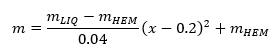
Where mLIQ is the liquid orifice flow rate and mHEM is the HEM flow rate. At xth = 0.2, the term (xth − 0.2)² / 0.04 equals zero and the equation gives mHEM, recovering the Part 1 result at the upper boundary. At xth = 0, that term equals 1 and the equation gives mLIQ, recovering the saturated liquid result at the lower boundary.
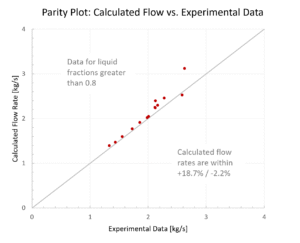
For required relief rate determination, this quadratic form consistently overestimates the flow rate across the transition range, which is the conservative direction. The overestimate is not large, but the conservative behavior is a deliberate property of the fit.
An open question. Richardson’s finding that the liquid fraction at the throat provides the best correlation suggests an interesting further investigation: whether void fraction at the throat would be a better independent variable than quality, as ISO 4126-10:2010 §6.5.2 implies.2 The related question is whether the slight discharge coefficient dependence on liquid fraction observed in Part 1 is simply the non-equilibrium effect extending across the full two-phase range, rather than a separate phenomenon. We haven’t pursued this yet; if the answer proves useful enough to change the interpolation approach, we’ll update this post with the findings.
Claude Sonnet 4.6 (Anthropic) was used as a drafting tool in the preparation of this post.
0 Comments
Post a Comment