

Tube failure characterization (CCPS GPREH2 trim)
Tube failure in a shell-and-tube heat exchanger is the common structural-failure basis for overpressure protection.1 Before the relief load can be sized, the designer has to decide what kind of failure to design for. The general types of tube failures that occur include the following:
- Small leak (corrosion hole), typically characterized as flow through an orifice having a diameter of 1/8″ to 1/4″ and a thickness equivalent to the tube thickness,
- Longitudinal split (also referred to as “fishmouth,” see Figure 1), typically characterized as full flow through the tubesheet on one side and the tube itself on the other side into the low-pressure side,
- Guillotine break, typically characterized as a clean break between the tube and tubesheet with full flow through the tubesheet on one side and the tube itself on the other side into the low-pressure side, and
- Catastrophic guillotine break, typically characterized as multiple guillotine tube failures occurring simultaneously (i.e., one tube breaking suddenly and hitting nearby tubes).
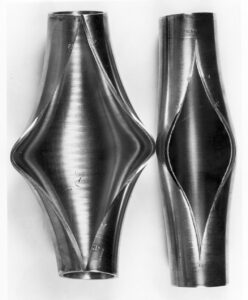
The tube rupture characterization normally assumed is based on a complete shearing of the tube at the tubesheet (3. guillotine break). There is some evidence that, for non-corrosive and clean service, this failure mode is far less common than a longitudinal split or small hole. Because the sizing basis for a longitudinal split at or near the tubesheet is the same as for a guillotine break, the results from these characterizations are usually the same. The exception is the scenario where there is a potential for inertial effects, in which case the longitudinal split may result in significantly higher transient pressures (these inertial effects are discussed in Part 4). Several factors affect the type and severity of the failure. When the high pressure is on the shell side rather than the tube side, a total failure is much less likely; the tubes tend to collapse rather than split open. Tube vibration, corrosion, stress corrosion cracking, and water hammer also affect the likelihood of failure and should be considered in selecting the sizing basis. The designer should also evaluate other possible events, such as roll-joint failures.
Small leak. When no credible break scenario can be established but prudence dictates that some relief capacity be provided, the designer may select a sizing basis less severe than a total tube failure. For example, when the pressure environment is mild and the heat exchanger is not considered vulnerable to tube vibration, corrosion, cracking, and other possible events, the designer might select a 1/8″ orifice and a 0.7 flow coefficient as a conservative basis. The decision should be made only after considering the risks, including fugitive emissions, associated with the larger relief devices required for the total-tube-failure mechanism. Multidisciplinary review is desirable when considering this small-orifice option. ISO 23251:2008 §5.19.23 indicates the following aspects of the exchanger design and operation can be considered to help determine the likely failure mode:
- Tube vibration,
- Tube material,
- Tube wall thickness,
- Tube erosion,
- Brittle fracture potential,
- Fatigue or creep,
- Corrosion or degradation of tubes and tubesheets,
- Tube inspection program, and
- Tube to baffle chafing.
Blog series information. This blog is part of a series on the proposed updates to the CCPS Guidelines 2nd edition §3.3 Venting Requirements for Nonreacting Cases that were removed during final editing. See the general CCPS Guidelines for Pressure Relief and Effluent Handling 2nd Edition review for more information.
[1] AIChE Center for Chemical Process Safety. “CCPS Guidelines for Pressure Relief and Effluent Handling Systems”. 2nd Edition, 2017; New Jersey: John Wiley & Sons, Inc.
[2] Simpson, L.L. (1972). “Tubing Rupture in Liquid-Filled Exchangers.” AIChE Loss Prevention Symposium, CEP Loss Prevention, 6, 92–98.
[3] ANSI/API Standard 521 / ISO 23251 (Identical), Petroleum and natural gas industries — Pressure-relieving and depressuring systems. 5th Edition, January 2007 (incl. Errata June 2007 and Addendum May 2008). American Petroleum Institute, Washington, DC.
We used Anthropic Claude [Opus 4.8] to assist with editing and converting a Microsoft Word manuscript into WordPress formatting.
0 Comments
Post a Comment